Materials for technical rubber goods: elastomers and compounds
Temperature, pressure and medium in use determine which material suits a rubber part. JRT processes all common elastomers and works with specialised compounders for the compounds.
Elastomer, raw rubber, rubber
According to the vocabulary standard DIN ISO 1382, an elastomer is a macromolecular material that quickly returns to approximately its original shape and size after substantial deformation by a weak stress once the stress is released. The base material is raw rubber. Only vulcanisation cross-links it into rubber with its elastic properties. In the titles of DIN 7715, soft rubber stands for elastomers, as distinct from hard rubber. JRT’s technical rubber goods are made of soft rubber or as rubber-to-metal bonds.
Long molecular chains, not yet cross-linked.
Accelerators, antidegradants, carbon black and colourants are added.
Vulcanisation cross-links the chains. Only now is the material elastic.
Which materials JRT processes
The range of materials covers all common rubber grades. If no standard grade is sufficient, JRT creates a special grade together with the compounders. Which material is chosen depends on the part’s requirement profile, and JRT makes a recommendation.
Besides EPDM, NBR, NR, VMQ and FKM, JRT processes other standard polymers such as SBR, CR, IIR, CSM, ECO and AEM as well as special materials such as HNBR and FVMQ.
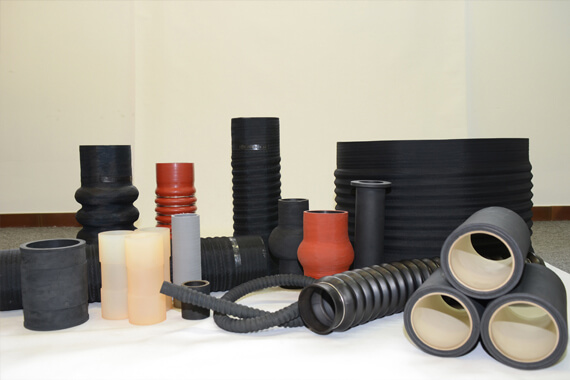
EPDM
EPDM is a terpolymer of ethylene, propylene and a diene. In its 2002 edition, ISO 2230 counts EPDM among the rubbers that are highly resistant to ageing. At JRT, EPDM is used among others in a sulphur-cured, halogen-free compound for moulded hoses in rail vehicles, matched to the fire protection standard EN 45545-2. Sulphur-cured means that the rubber chains are linked by sulphur bridges during vulcanisation.
Silicone
In the nomenclature silicone rubber has the code Q, and variants such as VMQ or PVMQ differ in the groups attached to the polymer. ISO 2230 in its 2002 edition also assigns silicone rubber to the group with the highest resistance to ageing. Parts made of some silicone rubbers shrink more after moulding, and according to ISO 3302-1 the tight tolerance classes M1 and M2 are very hard to achieve with them. Silicone hoses are part of JRT’s range.
Rubber-to-metal bonds
JRT bonds steel or brass to the rubber. Embedded metal parts affect shrinkage and therefore the tolerances that can be achieved.
Fabric as reinforcement
In hoses and bends special fabrics can reinforce the wall, and JRT makes both designs, with and without reinforcement.
The compound and the compounder
According to DIN ISO 1382, a rubber compound is the intimate mixture of rubbers or other polymer-forming materials with all ingredients needed for the finished product. Every substance added to the rubber for this purpose is called a compounding ingredient. The standard names, for example, vulcanisation accelerators, antidegradants, carbon black and colourants. JRT works with compounders whose business is the development and production of rubber compounds.
How the compound for your part is made
- 01First, JRT advises you on the planned part and what it will be used for.
- 02Then JRT takes care of the raw materials. JRT selects the material in close consultation with proven compounders.
- 03The compounders put the compound together to suit the intended use of the part.
- 04If the customer has special requirements, the base elastomer compound is developed specifically for them.
Together with the compounders, JRT continuously works on improving the quality and safety of the compounds.
Material and dimensional accuracy
Every rubber shrinks as it cools after moulding. How much depends on the rubber type and compound, and even varies between batches of the same compound. If special physical properties are required, the right compound cannot always be processed to tight tolerances. The tolerance standard ISO 3302-1 then recommends agreement between the parties.
Resistance by application
The resistance a part needs follows from its application. Examples from our range:
What we need to know to choose the material
What matters is which temperature and pressure conditions and which media the part must withstand. If it comes into contact with food or must be electrically conductive, please include that in your enquiry too.
FAQ: materials and rubber compounds
Which elastomers does JRT process?
All common elastomers. Our range includes, for example, EPDM moulded hoses for rail vehicles and silicone hoses.
What is a compounder?
A manufacturer that develops and produces rubber compounds. JRT works with selected compounders for raw material sourcing.
Can a compound be developed to my requirements?
Yes. The base elastomer compound can be developed to customer requirements, and special grades are made for special applications.
What is the difference between raw rubber and rubber?
Raw rubber is the uncured base material. Vulcanisation cross-links it and turns it into rubber.
Are there materials for contact with food?
Yes. There are suitable hoses and special parts for contact with food, and JRT confirms FDA compliance with a certificate on request.
Why does the material affect the achievable tolerance?
Because rubber shrinks after moulding and the amount of shrinkage depends on the rubber type and compound. With some silicone rubbers it is so large, according to ISO 3302-1, that the tightest tolerance classes are hardly achievable.